Poe discovers Landor’s guilt and confronts him
The Pale Blue EyePoe discovers Landor’s guilt and confronts him through a chain of clues that turns poetry and private notes into evidence. What begins as Poe’s effort to make sense of the Icehouse rite becomes a reconstruction of Landor’s crimes: the apparent occult pattern was a cover, and the investigator who had helped pursue the case was implicated in the deaths himself. The confrontation also exposes a more intimate betrayal: Landor had kept Mattie’s story from Poe, believing that Poe’s affection for him would prevent him from seeing the truth.
The missing heart and the return of memory
Poe begins his account with a problem left by the events in the Icehouse: there had been only one heart there. He had initially been unable to remember what happened in the chamber, describing his recollection as obscured by amnesia. Over the following days, however, details returned with increasing precision. The gap between his early inability to remember and his later detailed account gives the revelation its delayed structure: the explanation does not arrive during the rite itself, but through memory reconstructed after the danger has passed.
The single heart also unsettles the assumption that the rite was one of a series. Poe rejects the idea that the missing hearts had been stored for future ceremonies, reasoning instead that the ceremony was intended to be final. That conclusion leaves a question the apparent ritual cannot answer: where were the other hearts? Poe’s investigation shifts from the Icehouse to documents that had seemed personal or poetic, and the contradiction becomes the starting point for identifying another explanation.
Poems read as evidence
Poe’s next clue comes while he is reading Lea Marquis’s letters. He had declined to attend her memorial service, and reading her correspondence has become his way of honoring her. Among the letters he finds her poem for him, which he recognizes, on rereading, as an acrostic. On the stationery Poe brings out, the first letters of the lines have been enlarged; the pattern spells Poe’s own name. He had copied the poem for Landor before, but had not noticed what it said through its construction.
The acrostic alters the poem’s status. It remains an expression from Lea, but it is also a communication directed toward Poe, one that had been in view without being understood. Poe then applies the same method to another poem, the verse Landor had dismissed as metaphysically commissioned. Reading its line beginnings as a message, Poe identifies the words Mathilde died. He concludes that Mattie’s death had been conveyed through the poem, hidden in plain sight. Landor’s earlier request that Poe change the beginnings of the lines now appears to Poe not as a literary preference but as an attempt to prevent the message from being read.
These discoveries make poetry an instrument of recognition rather than mere ornament. The two poems do not disclose the same thing: Lea’s acrostic gives Poe his own name, while the other announces Mattie’s death. Together they lead Poe to ask why Lea would have wanted to bring herself to his attention, and whether her poem was intended to disclose a crime involving her own father. The possibility forces him to reopen assumptions he had previously treated as settled.
The notes and Patsy’s account
A second chain of evidence rests on handwriting. Poe places beside each other the note found in Leroy Fry’s hand and the note Landor had left for him, the latter recovered beneath their secret rock in Kosciusko’s Garden. Landor’s message urged Poe to take courage. Comparing the notes, Poe focuses on the capital letters A, R, G, and E, whose shapes are virtually identical. Their resemblance makes it possible that one person wrote both messages, raising a question the original investigation had not accounted for: why would Landor correspond with Fry?
Poe follows that question by asking Patsy what she knows about Mattie. He regards her as truthful and, while at Benny Havens' tavern, asks about Landor’s daughter. Patsy tells him what she knows: Mattie had been attacked by three unnamed ruffians, the same group Fry had characterized as a bad bunch. Landor had sought Patsy out on the day Mattie died, sworn her to secrecy, and then disclosed the terrible story. She kept his confidence until she decided that concealing it was destroying him. Her account links the handwriting clue to a personal history Landor had not shared with Poe, and explains how Poe learns of the assault without having witnessed it himself.
The disclosure changes the emotional terms of the investigation. Poe recognizes that he is now hearing someone peel away a hidden life, as he had once done to another person. His response is not simply that of a detective assembling facts: he understands that Patsy had carried Landor’s secret and that Landor had trusted her with it. When Poe later asks Landor why he turned on him, Landor answers that as long as Poe was partial to him, Poe would never see the truth. The confession identifies their closeness not as a protection against deception but as the very condition that made the deception possible.
Reconstructing Landor’s double role
Poe tests his revised understanding against the case’s central coincidence: the possibility that two different parties had designs on Fry on the same evening. His account provisionally distinguishes Lea and Artemus Marquis from a second party, whom he names Augustus. He reconstructs the latter as returning to his cottage at Buttermilk Falls after an interrupted but successful crime, then being summoned back to West Point the next day. From that second party’s perspective, the summons could have suggested that he had been apprehended; instead, he found that the mutilation of Fry’s body had created an additional crime and an unexpected opportunity.
In Poe’s reconstruction, the new crime furnished Landor with cover for his own act and led the authorities to seek his help in finding the people responsible. Landor could occupy the role of investigator pursuing crimes he had himself committed, while his apparent insight helped direct suspicion toward Lea and Artemus. Poe emphasizes the consequence: the pair risked being remembered as the murderers, though Landor’s later response is that they would eventually be forgotten like everyone else. The confrontation thus distinguishes the visible case from the concealed one. The supposed solution was also a means of shaping what the authorities believed had happened.
Landor’s answers confirm important parts of Poe’s reconstruction. He admits that the sheep and cows were his doing and explains that he removed hearts to make the deaths appear to be the work of Satanists. The staging was therefore deliberate: the heart removals gave the separate crimes a false shared pattern and helped provide him cover. When Poe asks whether Landor would have allowed Artemus to hang for his murders, Landor denies that he would have done so, while conceding that he expected to deal with the situation after Stoddard had been taken care of. The answer does not undo the danger Landor created for Artemus; it shows that he had allowed the accusation to stand while relying on a later opportunity to intervene.
The confrontation and its consequence
Poe’s method in the confrontation echoes Landor’s own investigative manner. He circles through the evidence, temporarily naming the parties and letting the logic of the reconstruction accumulate before dropping the indirection. The performance is pointed: Poe has learned not only the facts but also something of Landor’s way of making a case. His composed recital forces Landor to hear his own history reconstructed by the person he had expected to remain unable to see it.
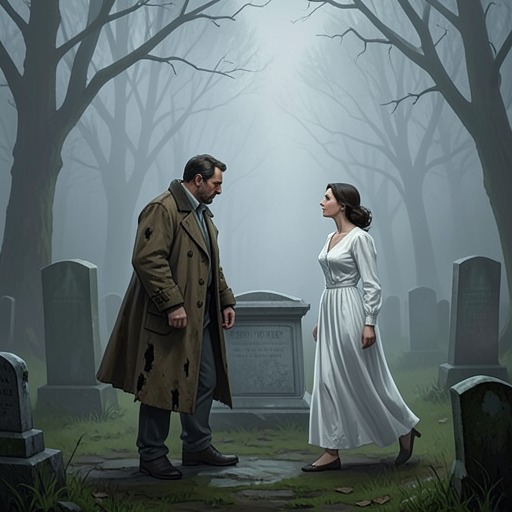
The exchange ends on the question of betrayal rather than on a further clue. Poe asks why Landor turned on him; Landor says his affection had blinded him. Poe nods, and his chin sinks with each movement. The discovery has reversed their former positions: the investigator who once drew hidden lives into the open is now the person whose own life is being interpreted, while Poe becomes the one who can see through the bond between them. Their partnership has supplied the means of recognition, but its intimacy has also made the betrayal possible.